Expense Trackerfor everyday life
Track every expense five different ways — typed, spoken, scanned, imported, or straight from your bank SMS. Then see what you own beside what you spend. Any currency, one app, in 10 languages.
- 5
- ways to log an expense
- 10
- languages
- ₹0
- to get started
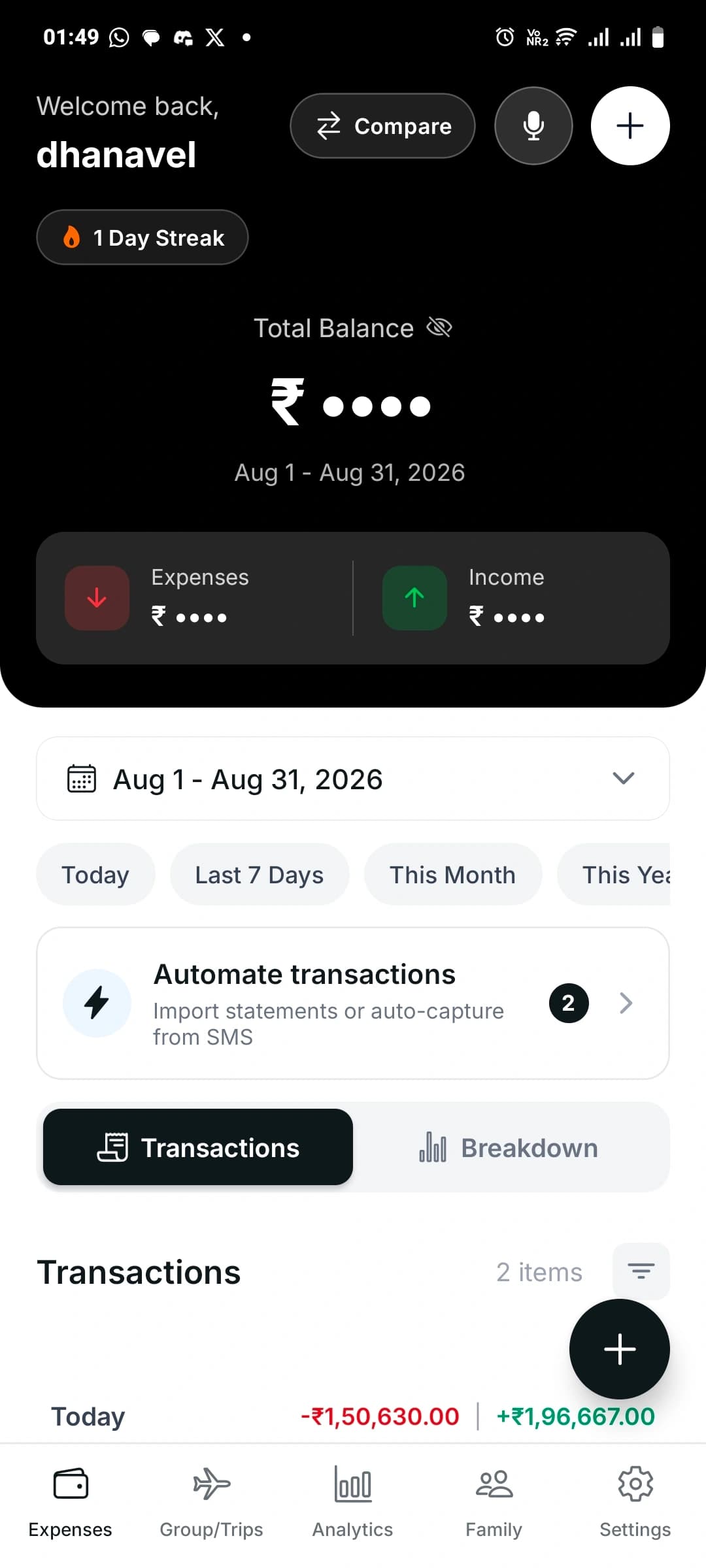
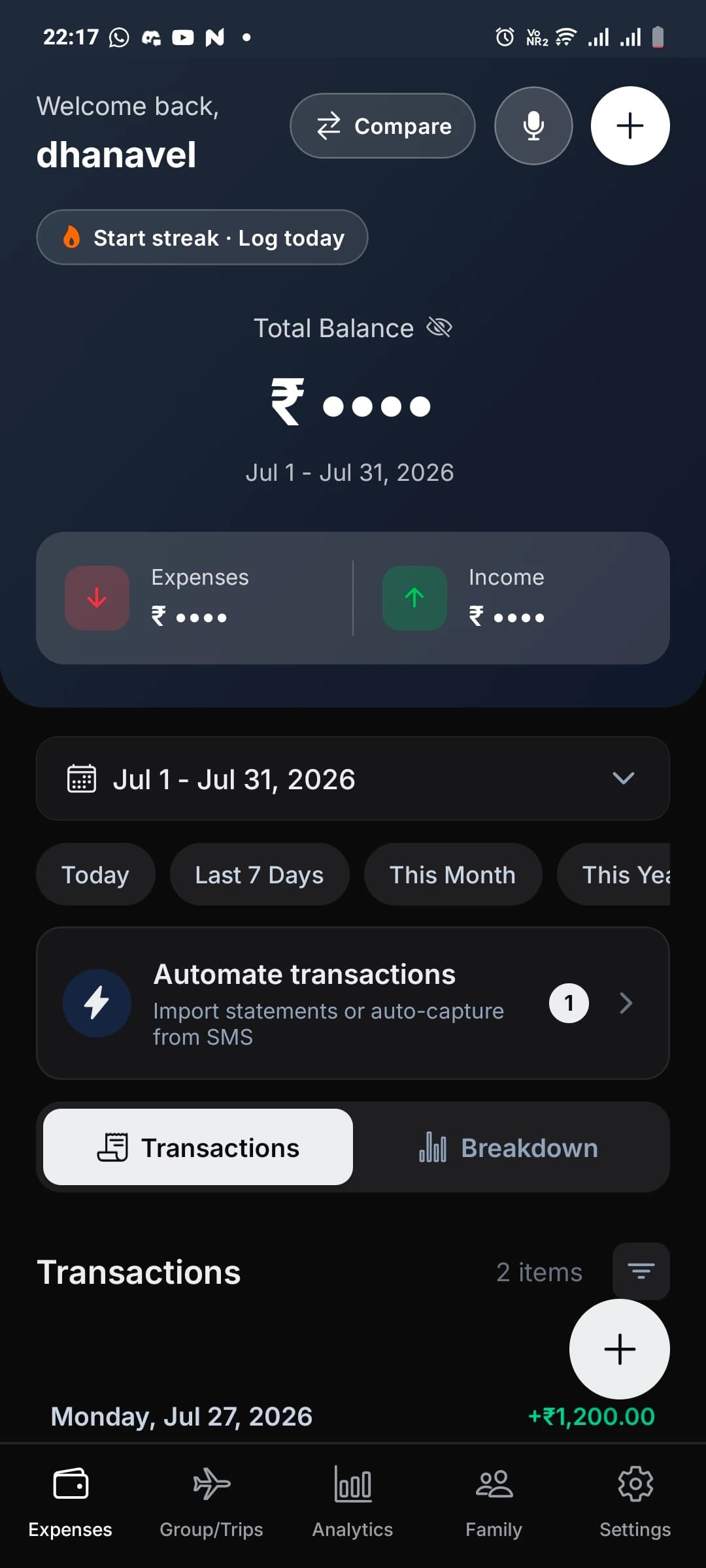
Getting it in is the hard part. So we made five ways.
Every other tracker dies at data entry: type everything, every day, forever. Nami gives you five ways in, so logging never becomes the chore that makes you quit.
Pick one, pick all five, switch anytime. Four are free; bank SMS needs Plus.
- Type it2 seconds
Amount first, done in two taps. It remembers your last category, so the everyday expense is nearly instant.
- Say itVoice
Say "dinner 300" out loud. Nami hears the amount, merchant, and category and logs it for you.
- Scan itCamera
Point at any bill. AI reads the line items, so you can split or save without typing a rupee.
- Forward itAndroid SMSIncluded in Plus
Bank and UPI texts become draft expenses on their own. You just glance and approve.
- Import itCSV / PDF
Drop a bank statement and months of history categorize themselves in one go.
Spend anywhere. See it in your money.
Pick the currency you think in. Nami keeps every total there, so a trip abroad never turns your budget into a puzzle you have to solve later.
- Your currency, chosen once. At sign-up or any time in Settings.
- Enter what the shop charged. Nami converts it as you save.
- The original stays on the receipt. You can always see what you actually paid.
One expense, two currencies
$100.00
Coffee & lunch, San Francisco
₹9,496
In your currency
Converted at the rate on the day you spent it, and pinned there — so last month's total stays last month's total.
You track what leaves. Now track what stays.
Add your stocks, funds, FDs, PPF, gold and crypto — from 20 Indian providers or any you name yourself — and see everything you own as one number, in the currency you think in.
- 16 asset types, from equity and mutual funds to EPF, property and crypto
- Allocation by asset type and by provider, so concentration is obvious at a glance
- A gain is only reported when Nami knows what you paid for enough of the portfolio to mean it
Holdings are entered and updated by hand today. Zerodha and Groww sync is next — this line will say so when it is live, and not before.
Cost known for 82% of the value. The rest counts toward the total, never toward the gain.
Where it sits
- Mutual fundsKuvera₹4,20,000
- EquityZerodha₹2,85,000
- PPFSBI₹1,60,000
- Fixed depositHDFC Bank₹1,00,000
- Digital goldSelf₹35,000
And everything else, already in the box.
Capture is the hard part. The rest is why Nami stays your only money app. Budgets, bills, family, trips, net worth and streaks, all built in.
Recurring Templates
Save rent, EMIs, and subscriptions as templates. One tap to log a repeat, never re-type a regular bill.
10 Languages
Use Nami fully translated in English, Hindi, Tamil, Marathi, Telugu, Gujarati, Kannada, Odia, Malayalam, or Bengali.
Home-screen Widgets
Check your balance and add an expense (typed or spoken) straight from the Android home screen.
Offline Mode
No signal? Keep logging. Expenses queue on your phone and sync automatically once you're back online.
Budget that actually warns you in time.
Set category-level budgets and get smart alerts at 50%, 90%, and 100% thresholds. Spot overspending patterns before they become habits.
- Category-specific budget limits
- Smart alerts at 50%, 90%, and 100% thresholds
- Monthly and annual budget history
- Budget adherence score tracking
Monthly Budgets
₹0.0k/ ₹26k
₹9.7k remaining
Entertainment is at 96%. You're close to your monthly limit.
Rent went up in October. September still tells truth.
Most apps overwrite a bill when you edit it, and last month quietly becomes a lie. Nami keeps the history instead: change an amount and only the months from there on move.
- Rent, EMIs, subscriptions and utilities in one list, each with this month's status
- Paid, due soon, overdue or upcoming — worked out fresh for the month you're looking at
- Two reminders per bill: one before it's due, one if it slips. Never the same nudge twice.
October
- RentPaid· Due 1₹28,000
- Home loan EMIPaid· Due 5₹41,300
- BroadbandOverdue· Due 12₹1,199
- ElectricityDue soon· Due 18₹2,140
- GymUpcoming· Due 28₹1,500
Rent rose this month. September still reads ₹26,000, because that is what September cost.
Manage the whole family's money in one place.
Create a family group, assign roles, set spending limits per member, and track shared goals and bills together. A family financial health score shows where you're thriving and where to improve.
- Admin, Member, and Child role types
- Per-member spending limits
- Shared family budgets, bill tracking and goals
- Family health score across 4 metrics
Sharma Family
3 members
Split trip expenses without the awkwardness.
Create a trip, add participants, log expenses, and choose how to split: equally, by percentage, or exact amounts. Everyone sees what they owe in real-time. No more WhatsApp calculations.
Give each trip its own currency — everyone sees the same shared total, while your share lands in your ledger in yours.
- Equal, percentage, and exact amount splits
- Participant roles: owner, manager, viewer
- Real-time settlement tracking
Goa Trip 2026
4 participants · ₹10,800 total
Scan the bill, split it instantly.
Point your camera at any restaurant or store bill. AI reads every line item, you assign who owes what, and the trip expense is logged automatically. No typing, no arguments.
- AI reads printed & handwritten bills
- Assign individual items to each person
- Shared items split equally or by custom ratio
- One tap to add to trip expense
Bill Scanner
Spice Garden · Table 7
Total
₹1,089
Import your bank statements in seconds.
Upload your CSV or PDF bank statement and our AI engine categorizes every transaction automatically. Review, adjust, and confirm: your entire financial history in minutes, not hours.
- CSV and PDF bank statement support
- AI-powered automatic categorization
- Review and edit before confirming
- Bulk import with job status tracking
- Handles multiple banks and formats
Drop your bank statement here
CSV or PDF · HDFC, SBI, ICICI, Axis and more
HDFC_March2026.pdf
156 transactions · AI categorized
Swiggy Food Order
Food & Dining
HDFC Salary Credit
Income
Netflix Subscription
Entertainment
PhonePe Transfer
Transfer
Habits that make tracking stick.
An expense tracker only works if you open it. Streaks, badges, and category-linked savings goals keep you coming back, plus one smart reminder at 8 PM that only fires if you haven't logged yet.
- Daily logging streaks with personal-best records
- Badges for real milestones: first log, week streaks, budgets kept
- Savings goals linked to categories, progress fills in on its own
- One smart daily reminder, skipped when you've already logged
0day streak
Longest: 21 days
Badges
Nothing logged today. 30 seconds keeps your 12-day streak alive.
It reads your spending so you don't have to.
Four things Nami works out on its own each month, written in whichever of the ten languages you use. When there isn't enough history yet, it says so instead of inventing a pattern.
What changed this month
A plain-language account of where this month went differently from the last — sentences, not a chart you have to interpret.
You spent ₹4,200 more than August, nearly all of it on food — 14 delivery orders against 6.
Subscriptions you forgot
Nami finds standing payments in your own history, including the ones you stopped noticing you were paying.
3 standing payments found — ₹649 and ₹199 monthly, ₹1,499 a year.
Charges that don't look like you
Measured against your own past, not a generic threshold. A quiet month says so rather than manufacturing an alert.
₹8,400 at a pharmacy. Your usual there is about ₹600.
Categories, tidied
Points out transactions that landed in the wrong category, and moves the ones you accept in a single tap.
6 transactions look like Transport, not Shopping. Fix all?
Every card is allowed to come back empty. “Not enough history yet” and “nothing unusual this month” are real answers here.
And the whole record, whenever you want it.
Every rupee you've tracked in one view. Export any period as a PDF or CSV, or put two months side by side to see exactly what moved.

10 Languages
Money talk, in your language.
The whole app and website are fully translated: English plus nine Indian languages. Switch anytime from your profile, and every screen, budget, and reminder follows instantly.
Same account, same data, just a different language.
Free financial planning tools.
Plan, project, and pressure-test your money. All eleven are free, and none of them ask you to sign up.

Budget Planner
Plan your monthly budget with the 50/30/20 rule and get a health score.
Savings Goal
Plan any goal. See how much to save each month to hit your target.
SIP Calculator
Project how monthly SIP investments compound into wealth over time.
Retirement
See your projected corpus and whether you're on track to retire comfortably.
EMI Calculator
Work out the monthly EMI, total interest, and payment for any loan.
Home Affordability
See how much house you can afford based on income, EMIs, and lifestyle.
Emergency Fund
Find your safety-net target based on expenses and risk profile.
Debt Payoff
Compare snowball vs. avalanche and see your debt-free date.
Inflation
See what your money will be worth in the future, or what past money is worth today.
In-Hand Salary
What your CTC really pays monthly
Currency Converter
Live rates, no sign-up
Your financial data is protected at every layer.
Security built in from day one. Biometric authentication, PIN protection, encrypted storage, and granular privacy controls keep your data where it belongs, with you.
Biometric Auth
Use Face ID or fingerprint to access your account on trusted devices.
PIN Protection
Set a custom PIN as an additional layer of security for your account.
Privacy Controls
Control what family members can see with per-member privacy settings.
Works Offline
Log expenses with no connection. They're stored on-device and sync the moment you're back online.
What is Nami? Common questions
Referrals
Give 30 days. Get 30 days.
Share your link and the offer runs both ways — they start on Plus, and you earn the same once they are actually tracking.
Up to 12 friends every 30 days.

Take control of your finances, starting now.
Free, on web and Android, in your language. Start with what you spent today, the rest follows.